November 6th, 2009 by Rachel | Country: France | 4 Comments »
This blog post is a response to a tweet by @Journeywoman who wrote a tweet recently:
“JW Tip of Day Put your camera down for a while. Now you can create travel memories in your mind.”
I am going to copy and paste a comment that I wrote on Greenheart Travel’s blog entry on why it is perhaps viable to put the camera down.
I have a little different thought as a college student who is studying photography at an art university. I actually find that photography allows me to appreciate even more what I’m seeing surrounding me because it allows me to stop where I am situated and think and stare at the space for several moments. As an artist, I don’t just stand there and snap a shot. I stand at the spot for several seconds and think about how the space means to me. As I’m thinking, I think about how I exactly want to shoot the photos, which includes where do I exactly want to shoot and what composition. On top of that, since I use an SLR camera, I also have to think about the technical aspects such as the aperture, shutter speed, and ISO. When I think about the technical aspect, I have to think about if I want the background to be blurry or sharp and if I want to see blurred motion or frozen motion. So, all of these decisions play an important role to what message am I trying to tell the viewers.
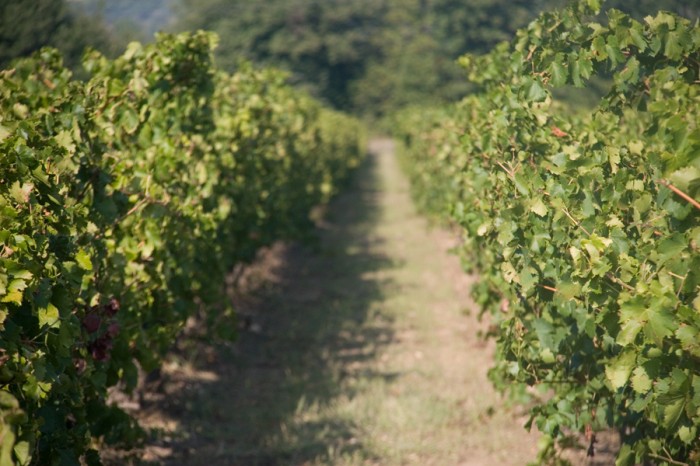
Then, when I come home and see the pictures, I always feel as if I’m reliving through the memories. I can definitely tell you that I’m always going through my blog archives just to pretend that I’m living through the moment again as I feel that I can step inside the picture. In fact, sometimes I never realize how grand many of the places are until I see the pictures!
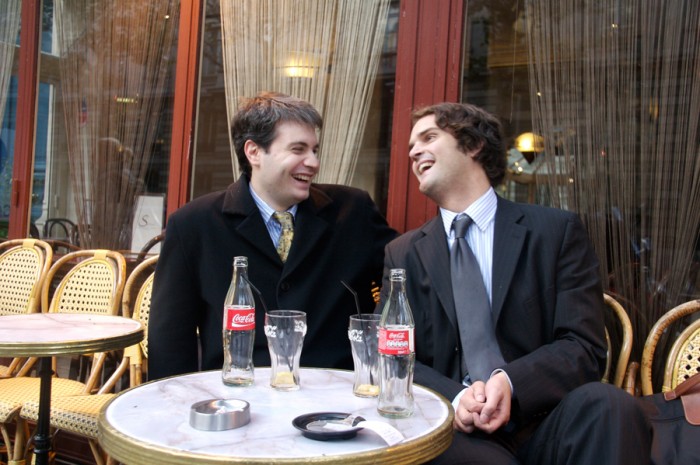
Another thing – Photography allows me to meet new people because I absolutely love doing documentary photography. So, when I photograph people, not only I take a snapshot of them, but also, I always try to communicate with them to learn more about their life and culture, and of course, if the country is speaking a foreign language, it gives me the opportunity to practice speaking in its language! I always think of my camera as a tool to broaden my vision of the world surrounding me.
Another food for thought – because one of my main goals as a travel photographer is to capture the culture and the lifestyle of the locals, I need to venture beyond the tourist spots and visit the places where the locals live. So, photography is giving me a way to motivate me to venture the off beat tracks.
November 4th, 2009 by Rachel | Country: France | 2 Comments »
“To be sure, the reproduced work of art is much more accessible. Thanks to photographic technology, any schoolchild can see a pretty accurate picture of The Last Supper in a book or the Internet. No expensive airfare or museum admission needed. The reproduction democratizes art.” – Life Inc. by Douglas Rushkoff
As an artist who studies art history, I have to disagree that seeing an accurate picture of an artwork in a book or the Internet is not as invaluable experience as it is seeing the work in person. We can’t see the texture of the brushstrokes in photographs, but we can in person. Seeing the textures of the brushstrokes are so astonishing that we feel tempted to touch the paintings. For instance, at Musée d’Orsay, we can view the surface of Claude Monet’s paintings in person. The brushstrokes are obviously think as we can see the depth of the individual strokes.
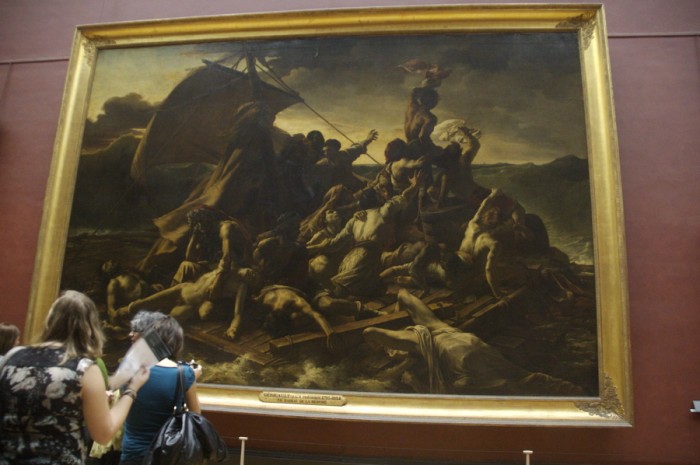
Some paintings are so big that they can’t fit on a projector screen. For instance, Gericault’s painting of The Raft of Medusa is ten times taller than an average person. It’s so big that I often feel as if I can step inside the world of this painting. I can stand and stare at the painting for several minutes and feel as if I’m part of the drama occurring inside the image.
Aside from paintings, seeing sculptures in person is a must. Viewing sculptures in person gives us the opportunity to walk around the sculpture and sometimes to touch them to feel the textures. For instance, seeing the sculpture of David by Michelangelo in Florence is completely astounding. I was able to see the details of the veins in David’s body and the texture of the muscles, something I was never able to see in the images.
There is a reason why travelers visit museums and that is simply because experiencing the viewing of the works of art in first hand is invaluable.
November 3rd, 2009 by Rachel | Country: France | No Comments »
In spite of Provence being located south of Paris by nine hours car drive, there is a very close connection between these two areas. No one can miss visiting Paris if they’re visiting Provence. First of all, one can take the speeding bullet train, TGV, from Marseilles or Avignon to Paris within 2 and a half hours – short enough to take a quick day trip or a weekend trip.
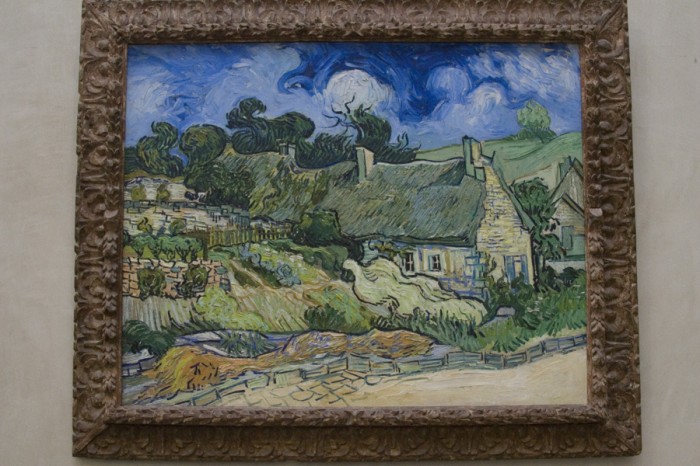
Paris has a bountiful of museums with exhibitions featuring works from Provence. The most prominent place is Musée d’Orsay where a good number of artists from Provence are featured such as Vincent Van Gogh, Paul Cezanne, and Henri Matisse. When I look at the paintings, in particular the impressionist paintings, I feel as if I’m living voraciously in Provence and relaxed.
Pompidou Centre has a marvelous exhibition of works featuring Provençal scenes such as l’Estaque, a painting by Georges Braque depicting a fishing town near Marseilles.
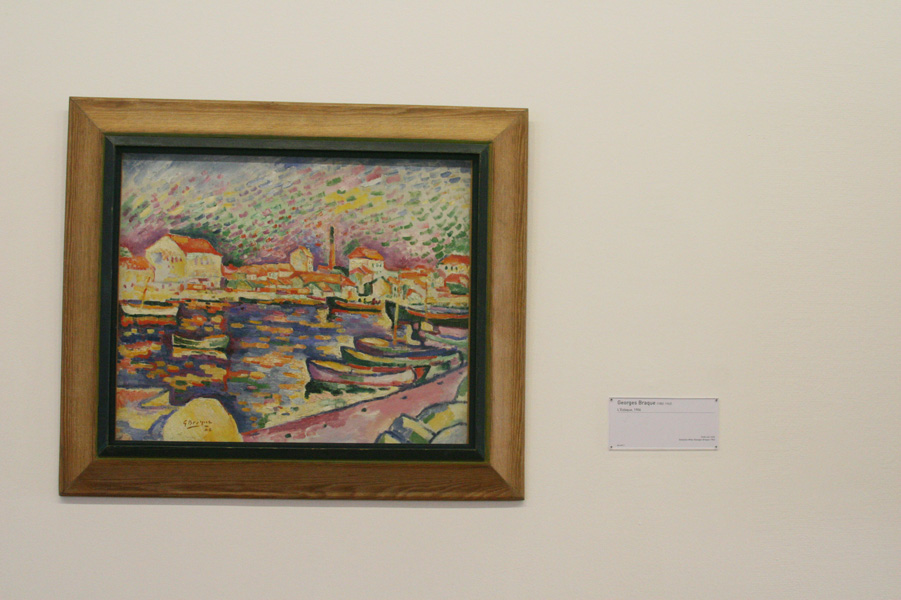
l’Estaque by Georges Braque
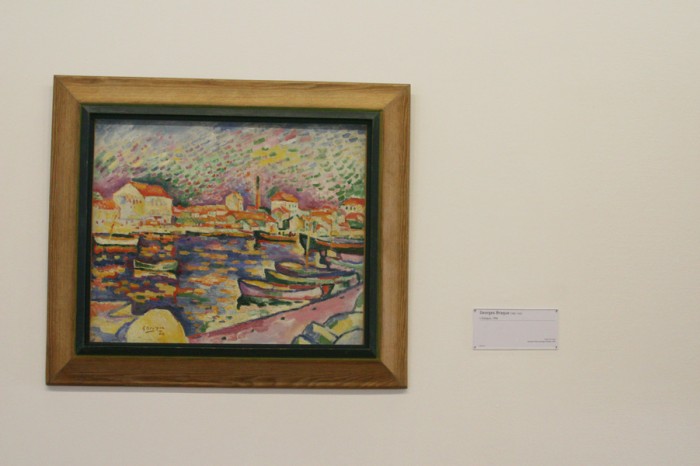
l’Estaque by Georges Braque
Most importantly, enjoy Paris as a city with a completely different lifestyle from living in the countryside!
November 3rd, 2009 by Rachel | Country: France | 1 Comment »
When I was in Paris in 2006, I saw only ONE Starbucks in the entire city of Paris, and it was located right by la Défence. Then, when I was in Paris last summer, I saw at least one Starbucks in each arrondissement. However, this past recent trip to Paris was completely different. I encountered Starbucks on every block in the city! In fact, there are about 40 Starbucks total according to the store locator on their website. While I dearly love Starbucks as frappuccinos are the only caffeinated drinks that I can drink – this place is my life saver during the intense moments at home such as finals! However, I don’t mind Starbucks existing in the US, my home country, because it was founded in MY culture AND cafes barely existed in the US unlike France.
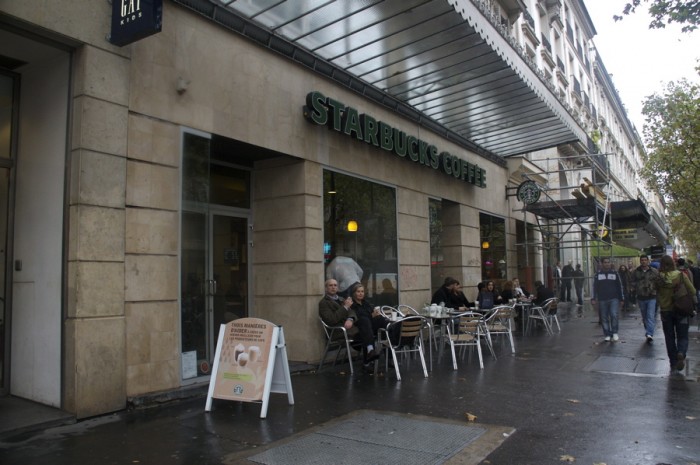
France is already loaded with a huge range of various cafes with their own unique menus. Starbucks did not need to come to France. In fact, at one point, a friend of mine from Paris, told me that we should meet up at Starbucks. I told him hell no because I already have Starbucks in my country, and I’d rather enjoy being at a cafe that does not exist in my home country. I asked him why he prefers Starbucks over all the other distinct cafes. He responded, “They’re cheaper, and their stuff tastes really good.” When I heard the word, “Cheaper,” my ears were puffing out steams. That was the last thing I wanted to hear. As someone who knows the behind the scenes of Wal-Mart, America’s mega big box corporation, through reading articles in the news, that meant that Starbucks could create a dangerous impact on the society in France. Wal-Mart caused nearby unique and non-chain stores to close. In fact, according to the book, Life Inc. by Douglas Rushkoff, for every two jobs created at Wal-Mart, the local community loses three jobs according to the Congressional Research Service report. From what I saw of the explosion of Starbucks in Paris, I can foresee cafes closing and causing their employees to lose their jobs – a parallel that I see with the Wal-Mart trend. This is just simply an analysis of mine, and I’m not saying that this case will happen. I’m just creating a theory.
It’s a really sad thought…
Also, the fact that my friend from Paris mentioned that Starbucks is cheaper than other cafes, I wonder how well the employees are treated as the employees at Wal-Mart not well treated according to various sources in the news media.
November 3rd, 2009 by Rachel | Country: France | No Comments »
While I have a background in art history, I’ve only studied yesterday’s works and some current works. As an artist, it’s very important to have a well-rounded knowledge of art history so that I can understand the purpose of the concepts that exist in many works of art and why and how the concepts were developed. Often times, past works of art inspire me to create something. On the other hand, in order to move forward, I need to see art in trends that are occurring today and the trends that I could foresee. Timing could not have been better when I visited Paris two weeks ago as a huge art show was in action – Fiac!

This was the place where I could see works of art that are in trend today and that have potential to be in tomorrow’s art history textbooks. Before I go on, I’d like to share a photo that I took of an installation that I feel that is crucial to our studies in art.
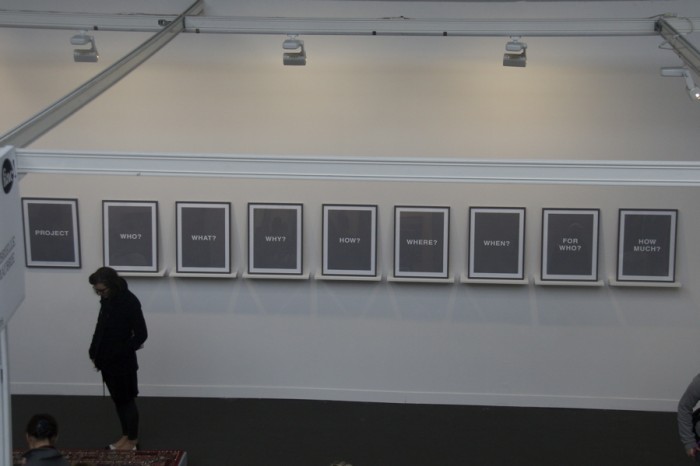
In order to create an work of art and to put it in a show, we all certainly have to answer these questions! I have to admit that answering all of these questions – Who? What? Why? How? Where? When? For Who? How Much? – is not an easy task. Often times, artists mumble and say, “I just like the way this piece looks.” They need to go farther by asking WHY do they like the way the piece looks. Also, there are reasons to why we are creating art pieces and by that means, we have to answer the question – WHY are we creating the work of art and FOR WHO[M] are they for? While we are utilizing our creative minds when it comes to creating work of art, we are also using our critical thinking skills to answer these questions.
I am guilty to say that I unfortunately did not record the artist’s name of the one whom created this fantastic installation. If anyone know who did this piece, I would appreciate your letting me know.
Fiac is such an incredibly big art exhibit – it took up the entire space at the Grand Palais, a very well-known architecture built from 1897 to 1900 for the Universal Exhibition in 1900, and there was also another exhibition at the Louvre. I was certainly overwhelmed by the number of pieces; however, I found a few unusual work that are worth mentioning.
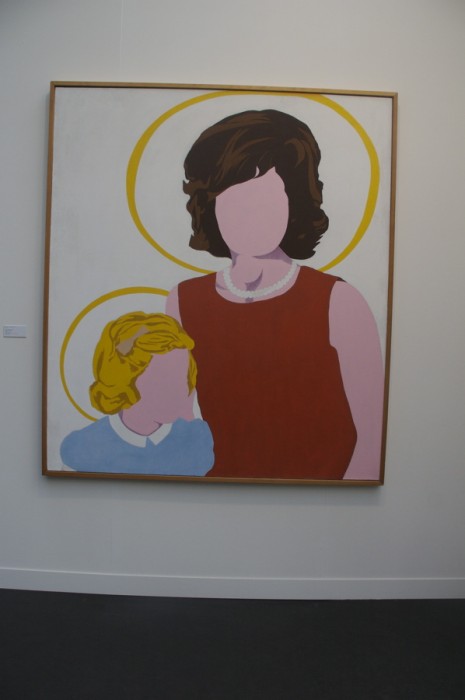
When I first saw this painting, Madonna and Child by Allan d’Arcangelo, I was completely intrigued by the lack of facial appearance. I was even more intrigued by the title of the work. Is there a symbolism of anonymity in this work? Perhaps because there are no facial features and in order to know who are the people, it is necessary to see the facial appearance in order to see the facial expressions and perhaps to recognize the person. The title is certainly interesting while it doesn’t appear to be a typical Madonna and Child painting although there are halos behind the mother and the child. This painting is probably depicting the notion of today’s Madonna and Child.
November 1st, 2009 by Rachel | Country: France | No Comments »
Without any doubts, recording memories of traveling through Provence is a must. Everywhere I go, there are always a breathtaking scenery – cliffs, mountains, and vineyards. There is this particular route, from Lacoste to many places including Avignon, Isle sur la Sorgue and Fontaine de Vaucluse, that I can never forget. I remember vividly the day I first arrived to Lacoste last year in September on a beautiful sunny day. The first thing I saw was giant cliffs and mountains on both sides of the roads. The curves and dents of these landforms are such a vital imagery to the scene as it creates deep shadows.
Besides seeing the image in this video, I also added a Provençal folktale song called Les Cordelles to enhance your journey through Provence!
November 1st, 2009 by Rachel | Country: France | 2 Comments »
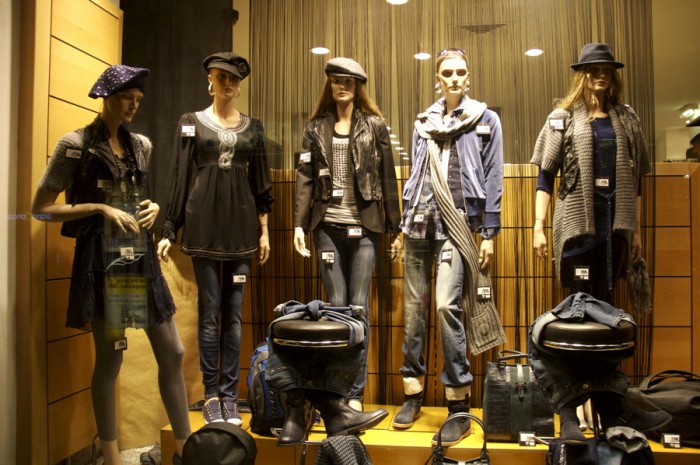
As I stroll through the city of lights, Paris, I glaze at the windows and admire the beautiful clothes displayed in the shop windows. One store has a pair of boots dazzled with silver sequins and another has a red coat with beautiful ruffles and flowers and another has a magnificent gray skirt fit to accentuate the curves of the body. Looking at the voguish garments draws my mind to say, “OoooooOOooo!” or “WOW!” or “I need to take a look!” One of the things that certainly makes Paris such a special city is that it has a wealth of unique clothing designs. They’re so different that I can look absolutely original.
There is a history behind to why fashion is a major hype in Paris and throughout France.
“French fashions must be France’s answers to Spain’s gold mines in Peru.” - Jean-Baptiste Colbert
When I was on the training heading back to Lacoste from Paris, I was reading a book called, Life Inc. by Douglass Rushkoff, and I came across a paragraph that explains how France became one of the fashion empires. During the Renaissance era, France could not keep up with the “heavy competition for resources in the New World, and began to run a trade deficit.” So, Jean-Baptiste Colbert, King Louis XIV’s finance minister, recognized that having a domestic production would be more effective which would lead to selling their goods to other countries. Rushkoff stated:
“Colbert envisioned a France capable of competing with the rest of the world not through the acquisition of territory and resources, but through style. He needed a way to make French exports seem special for their own sake, and took it upon himself to invest what we now think of as luxury goods.”
Timing could not have been better as my question was answered shortly after my trip to Paris!
October 28th, 2009 by Rachel | Country: France | No Comments »
A building appearing to be a house with light blue shutters nestles in middle of bountiful of trees with orange, red, and yellow leaves. The Gallo-Roman site of Glanum is locoated not to far from there. One would think it’s just a beautiful mansion; however, it’s a place for mentally ill people who would be provided with art therapy. This psychiatric health institution is called “Maison de Sante St. Paul.” Vincent Van Gogh was one of the patients who was there from May 1889 until May 1890, and it was one of the most important time of his life as an artist. Because he was inspired by his surroundings – the countryside, he produced over 100 drawings and 150 paintings. Like any other impressionist artists, he studied the lighting as he was intrigued by it.
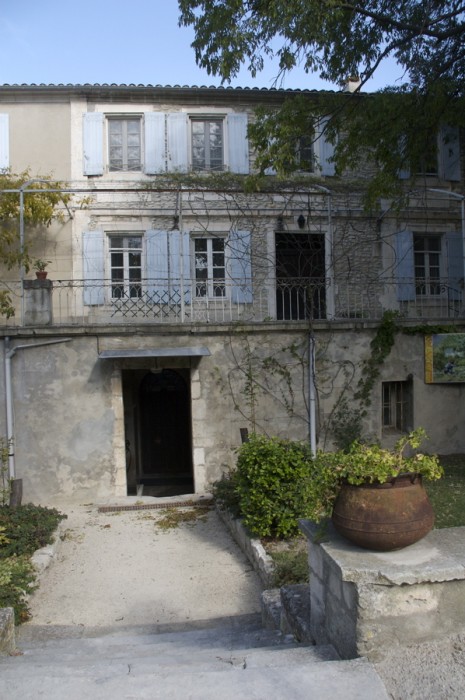
This “maison” was built in 11th century as a monastery dedicated to St. Paul the apostle. It was not until 1855 when the building became a psychiatric health institution. Inside the building, paintings and drawings adorn the walls, and many of them appeared to be inspired by the impressionist artists. These works were done by today’s patients.


After visiting Maison de Sante St. Paul, we headed to the town center of St. Remy, located about 20 km from Avignon, to tour the town and to have lunch together as a class. St. Remy is just another beautiful town in Provence with antiquated buildings made of stucco with shutters in various colors. Alphilles beautify the scene of the town.


October 20th, 2009 by Rachel | Country: France | 1 Comment »
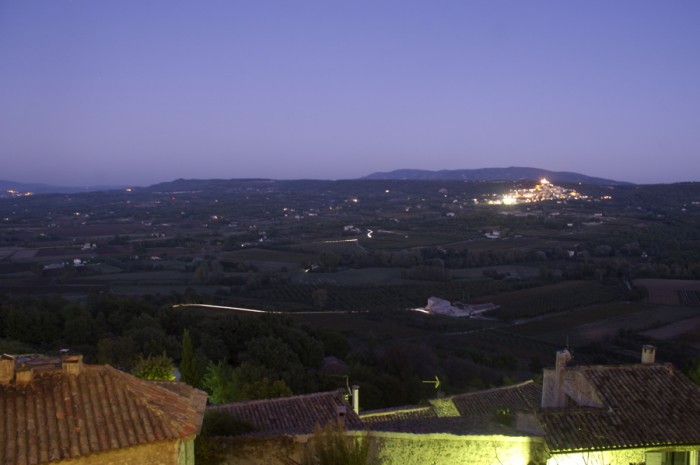
As I stand by a terrace in Lacoste where I’m currently living for two months, I gaze at the countryside which is filled with gems. A village across from Lacoste, Bonnieux, appears to look like a cruise as the lights twinkling like stars form a shape of a ship. Cars roaming through the roads create streaks of lights. Throughout the land, there are sparkling lights from there and there. Viewing the scene is just a piece of a serene moment.
October 19th, 2009 by Rachel | Country: France | 3 Comments »
Fall is my most favorite season. Not only I enjoy the cool breeze, but also viewing leaves in various colors on the trees. As I was heading to a field trip destination with my art history course last Thursday, I was amazed by the endless number of trees lining up on a road just outside of St. Remy de Provence. Riding through this road gave me a sense of constant rhythm and harmony. Because of the leaves in different colors, I felt as if I was riding through a rainbow. At that moment, I also thought of Edith Piaf’s song, “Autumn Leaves.”


